
Contractor Quality Guide
Roof Coating Quality Control: What to Check Before You Sign Off
Roof coating quality control is the set of checks that prove a coating was applied the way it was specified: the surface properly prepared, the weather right for coating, every coat at the correct thickness and the finished film free of defects. Most early coating failures trace back to one of those checks being skipped. A roof can look perfect on handover day and still be failing underneath.
- Coating quality is decided before the first coat. Surface preparation and site conditions matter as much as the product.
- Film thickness must be measured, not estimated. Ask to see the readings.
- Every defect should be recorded with a photo, its location and the date before it is repaired.
- A contractor who cannot hand over inspection records has nothing to back the guarantee.
Why Does Roof Coating Quality Control Matter?
Because a roof coating's lifespan is decided by things you cannot see once the job is finished. Poor preparation, coating in the wrong conditions or film applied too thin all look fine on handover day and only fail a few seasons later. By then, the contractor's inspection records are the only evidence of how the work was done, and the only thing that makes the guarantee worth more than the paper it is printed on.
"You are not buying paint. You are buying a properly prepared surface, a measured film of coating and a written record that proves both."
What Should Be Checked Before Coating Starts?
The surface and the conditions. Rust, loose coatings, dust, oil and salts must be removed to the standard named in the specification, and the roof must be dry and warm enough for the product to bond. Coating over a poorly prepared or damp surface is the most common reason a new coating peels or blisters early, and no amount of care later in the job can fix it.
Surface Preparation Grade
Steel surfaces are graded under ISO 8501-1, from hand and power tool cleaning (St 2 and St 3) to abrasive blast cleaning (Sa 1 to Sa 3). The specification should name the grade, and the prepared surface should be inspected against it before any primer goes on. Sa 2½ and Sa 3 are the grades most commonly specified for protective coatings.
Surface Cleanliness
Dust, oil and soluble salts stop coatings from bonding. Dust is rated under ISO 8502-3, and salts can be measured with a Bresle patch test (ISO 8502-6 and ISO 8502-9). Salt testing matters most on coastal sites, where salt air settles on the roof between washing and priming.
Weather and Dew Point
Air temperature, relative humidity and steel temperature are measured on site and the dew point calculated (ASTM D3276). The accepted rule is that the surface must be at least 3°C above the dew point, or moisture condenses under the coating. On many roofs, that rules out the early morning.
What Should Be Checked While the Coating Goes On?
The mix, the details and the thickness of every coat. Products must be mixed and used exactly as the manufacturer specifies, the vulnerable details must be coated separately, and the wet film must be measured as it is applied. Checking during application lets thin or missed areas be corrected while the coat is still wet, instead of being discovered after it has cured.
Mixing and Pot Life
Two-pack products must be mixed in the manufacturer's ratio and applied within their pot life and recoat windows. Material that sits mixed for too long cures poorly, however well it is applied.
Stripe Coats on Details
Laps, fixings, edges and penetrations get a separate stripe coat before the full coat goes on. These are the places where coatings are naturally thin, and the places where leaks and rust usually start.
Wet Film Thickness
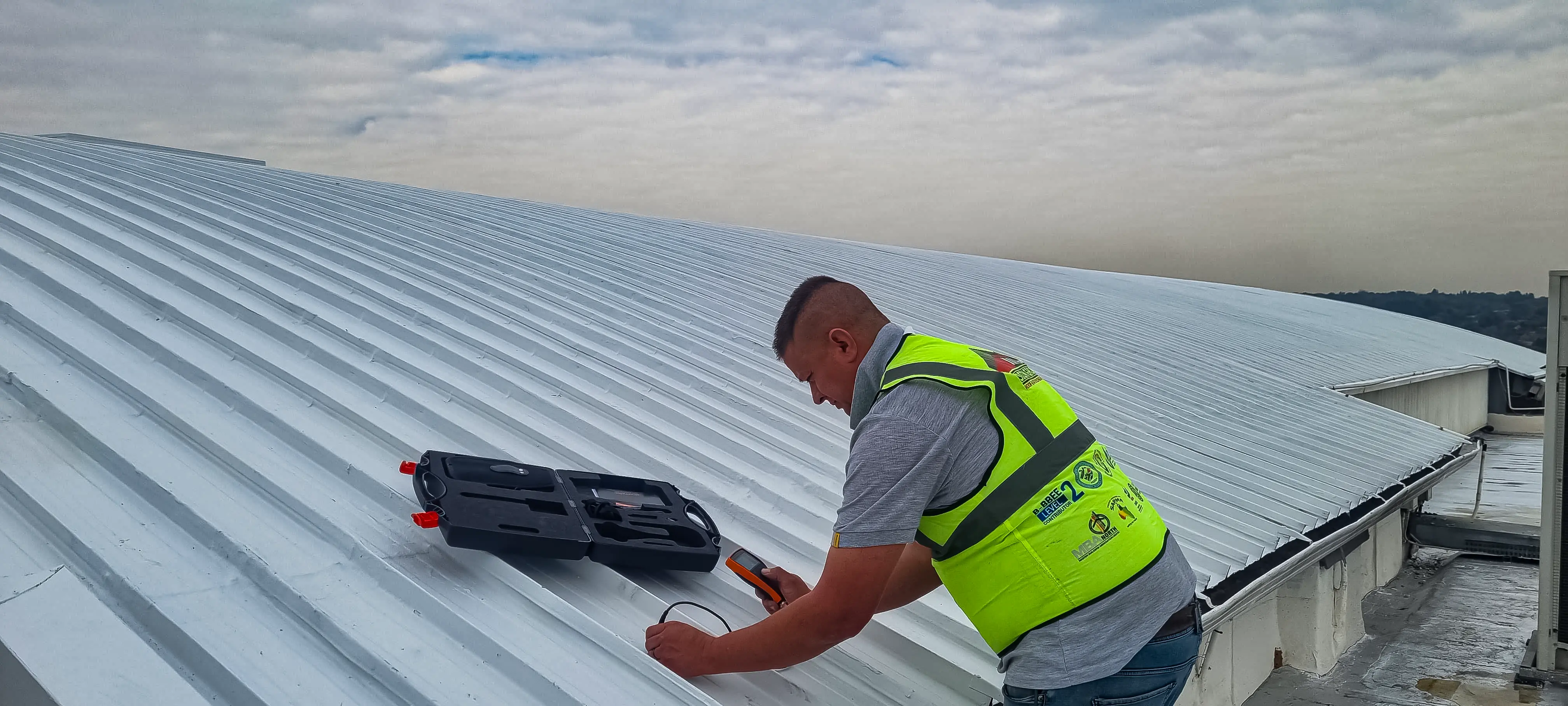
A comb gauge (ASTM D4414, ISO 2808) checks the wet film as it goes on. Because the wet reading predicts the dry thickness, it is the cheapest point in the job to catch a coat that is being applied too thin.
How Do You Know a Finished Coating Meets Specification?
By testing it, not by looking at it. Once the coating has cured, its dry thickness is measured across the roof, it is checked for pinholes and missed areas, its adhesion and cure are tested, and the whole surface is inspected for defects. Only when the readings meet the specification should the work be accepted and signed off.
Dry Film Thickness and Holidays
Dry film thickness is measured with a calibrated gauge (ASTM D7091, ISO 2808) against the minimum in the specification. A holiday test (ASTM D5162) finds pinholes and missed areas, known as holidays, that the eye cannot see.
Adhesion, Cure and Final Inspection
Adhesion is tested by pull-off (ASTM D4541) or cross-cut (ASTM D3359), cure is confirmed with a solvent rub test where the product calls for it, and the roof is inspected for visible defects before final acceptance.
Never accept a coating on appearance alone. A roof can look smooth and even and still be under thickness, poorly bonded or full of pinholes.
Which Coating Defects Should You Look For?
Our roof coating standard lists 25 paint and coating defects that every applicator and inspector must recognise. On roofs, these are the ones most worth knowing, because each points to a specific mistake in preparation or application:
- Pinholes and holidays: tiny holes or missed areas that let water reach the steel
- Blistering: bubbles rising off the surface, usually from moisture or contamination underneath
- Peeling and flaking: coating lifting away, the classic sign of poor preparation or adhesion
- Cracking and mud cracking: film applied too thick, or a product that cannot move with the roof
- Runs, sags and dry spray: uneven film from poor application technique or the wrong conditions
- Rust staining and underfilm corrosion: rust that was coated over instead of being treated
Our quality control rule is simple: every defect is recorded with a photo, its location and the date before it is repaired. That record is what lets anyone check, months or years later, that each defect was found and fixed. Corrosion found during inspection should be treated with proper rust and corrosion control, not painted over.
What Quality Records Should a Contractor Hand Over?
Enough to prove every check in this article was done. At completion, you should receive the specification, the inspection and test results with their locations, a log of every defect and its repair, and the final acceptance sign-off. These records support the guarantee and give the next inspector a baseline for the life of the roof.
- The coating specification and the product data sheets
- Surface preparation inspection results against the named grade
- Daily weather and dew point readings for every coating day
- Wet and dry film thickness readings, with where on the roof they were taken
- Holiday and adhesion test results
- A defect log with photos before and after each repair
- The final acceptance inspection and the written guarantee
How Do You Compare Contractors on Quality?
Ask each contractor to show you their written coating standard, the tests they will carry out on your roof and an example of the records they hand over. A contractor with a real quality system can answer all three on the spot. One without a system will talk about products and price instead, because there is nothing else to show you.
Sicon Group applies performance coatings and carries out full roof restorations to a published standard of seven surface preparation grades, 25 coating defects and 30 inspection and test types, backed by our quality control process and workmanship guarantees of up to 20 years. You can meet the coating and raw material partners behind our systems on our suppliers page, and find more questions worth asking in essential questions to contractors.
Frequently Asked Questions
What is dry film thickness on a roof coating?
Dry film thickness (DFT) is the thickness of a coating once it has cured, measured in microns with a calibrated gauge. Every coating system has a minimum DFT in its specification. Below that minimum, the coating cannot deliver its rated protection or lifespan.
How is roof coating thickness measured?
Wet film thickness is checked during application with a comb gauge, and dry film thickness is measured after curing with a calibrated electronic gauge. Readings should be taken across the whole roof and recorded with their locations.
Can a roof be coated early in the morning?
Only once the roof surface is dry and at least 3°C above the dew point. Morning dew and cold steel are common on roofs, so the dew point should be measured on site rather than assumed.
What causes a new roof coating to peel?
Usually poor surface preparation, coating over moisture or contamination, incompatible products, or film applied outside the manufacturer's limits. Each of these is caught by the quality checks in this article, which is why the inspection records matter.
Ask to See the Records
Talk to us about the preparation grade, inspections and quality records that suit your roof, and see the standard our teams work to on every coating project.